

History of Sharad Navratri: Origin & Meaning Explained
Why is Sharad Navratri such a Devotional celebration all over every year? It’s a complex and intriguing blend of ancient Hindu philosophy, sacred texts, inspirational folklore, and traditional wisdom. The Sharad Navratri celebration lasts 9 days and aims to praise Goddess Durga and her 9 forms during the Ashwin month in the Hindu calendar. It celebrates her victory over the demon “Mahishasura,” which represents good vs. evil, the good vs. one who fears evil, and the just man vs. the unjust.
In this complete guide, I will learn more about Sharad Navratri, its origin, its meaning, what it is associated with, its religious importance, and the ancient practices during Sharad Navratri.
What is Sharad Navratri?
Amongst the many festivals every Hindu celebrates, there is one dedicated to Goddess Durga, the personification of the divine feminine energy, strength, wisdom, and protection – this is Sharad Navratri.
Both Sharad and Navratri are Sanskrit words, and their meanings are:
- Sharad refers to the autumn season.
- Navratri Means “Nine Nights.”
Sharad Navratri means together the Nine Sacred Nights of Autumn. Sharad Navratri differs from those festivals which celebrate one event only, as it pays tribute to the nine merits of the gods:
- The triumph of righteousness over wickedness.
- Towards Shakti, or the Divine feminine power.
- Inner purification and self-discipline
- Devotion and spiritual awakening
- Gratitude and prosperity
The festival ends with the celebration of Vijayadashami (Dussehra), which represents victory, success, and new beginnings.
History of Sharad Navratri
The story of Sharad Navratri is of very old origin and is an integral part of the old Hindu aadhi-wadhikhi traditions. In early times, before the building of grand temples or public festivals, they revered the Divine Mother as their strength, protector, source of fertility and prosperity.
Sharad Navratri During the Vedic Period
The early Hindu texts of the Vedic era honored strong female energies, which keep the universe balanced. These beliefs were later developed into the worship of the Goddess Durga and her forms — Parvati, Kali (or Durga), and Ambika.
Sharad Navratri During the Puranic Period
During the Puranic age (across Vedic Yugas), Devi Durga was one of the most revered Hindu goddesses. The festival of Sharad Navratri originated from the story of her victory over Mahishasura, which is mentioned in the sacred scriptures such as Devi Mahatmya and Markandeya Purana.

Origin of Sharad Navratri
It is said that the most popular source of origin of this auspicious event is Sharad Navratri, which is a story from Hindu mythology of Goddess Durga and Mahishasura.
In ancient scriptures, Mahishasura was a powerful demon who was granted power by a boon of being almost impossible to kill. On the strength of this blessing, he set himself in heaven and defeated many of the gods and spread terror throughout the universe.
The gods were so scared of losing to him if he were attacked one after another that they combined their divine power. Out of this combined radiance emerged Goddess Durga, who was a valorous woman with tremendous strength and who was armed with celestial weapons bestowed by the various deities.
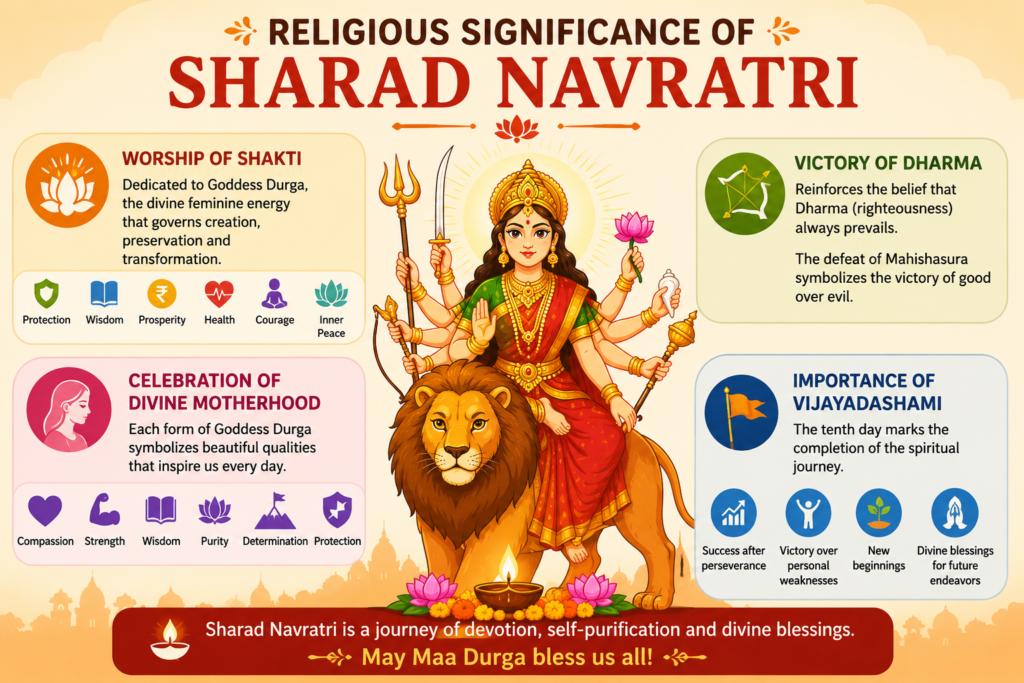
Religious Significance of Sharad Navratri
It is a time when one worships Goddess Durga, the universal mother of all, the source of divine energy, and that’s why it is one of the most sacred festivals in the Hindu religion.
Some of its major religious significances include:
Worship of Shakti
The main theme of Sharad Navratri is the celebration of the personification of Shakti, the feminine energy also known as the mother, who is known to be the divine energy for creation, preservation, and transformation.
Devotees pray to Goddess Durga for:
- Protection
- Wisdom
- Prosperity
- Health
- Courage
- Inner peace
Victory of Dharma
On Sharad Navratri, it is believed that there can be no defeat of Dharma (righteousness) in the Hindu religion.
The victory of Mahishasura teaches devotees that evil forces, injustice, and pride may gain power for a time, but they can never be victorious over truth and divine justice.
Celebration of Divine Motherhood
The festival also celebrates the nurturing aspect of the Divine Mother.
Every form of Goddess Durga represents a different attribute, such as:
- Compassion
- Strength
- Wisdom
- Purity
- Determination
- Protection
These are the attributes that lead the followers to develop the same ones in their everyday lives.
Importance of Vijayadashami
The tenth day, Vijayadashami, marks the completion of the spiritual journey undertaken during Navratri.
It symbolizes:
- Success after perseverance
- Victory over personal weaknesses
- New beginnings
- Divine blessings for future endeavors
This day is significant for many people because they make significant life changes, begin businesses, or start a new educational program or course.
Nine Days of Sharad Navratri
Sharad Navratri is celebrated for the next nine days, with each day honoring a particular avatar of Goddess Durga that symbolizes different types of virtues and blessings.
| Day | Goddess | Represents | Main Blessings |
|---|---|---|---|
| Day 1 | Shailaputri | Strength and new beginnings | Stability and courage |
| Day 2 | Brahmacharini | Devotion and penance | Wisdom and determination |
| Day 3 | Chandraghanta | Bravery and peace | Protection and confidence |
| Day 4 | Kushmanda | Creation and vitality | Health and prosperity |
| Day 5 | Skandamata | Motherhood and compassion | Family happiness and success |
| Day 6 | Katyayani | Courage and justice | Victory over obstacles |
| Day 7 | Kalaratri | Destruction of evil | Protection from fear and negativity |
| Day 8 | Mahagauri | Purity and forgiveness | Peace and spiritual growth |
| Day 9 | Siddhidatri | Divine perfection | Success, wisdom, and fulfillment |
Traditional Rituals of Sharad Navratri
There are several sacred rituals followed during the entire festival.
Ghatasthapana
The festival starts with the installation of the sacred Kalash, a symbol of Goddess Durga, and the beginning of the worship of Navratri.
Daily Puja
Devotees bow before Him every morning, every night, and offer him flowers, fruits, candies, and incense, and sing devotional songs.
Durga Saptashati Recitation
Many families recite the Durga Saptashati (Devi Mahatmya) during the nine days to seek protection and blessings
Kanya Puja
Prayers, gifts, and feasts are offered to young girls who represent the 9 forms of Goddess Durga on Ashtami or Navami.
Havan
Conduct a ceremony for a sacred fire-burning to give an attribute of blessing and purify at the end of this festival.
Read Also: Best Diwali Wishes for Family & Friends in 2026
Final Thoughts
Here, Sharad Navratri is more than just a religious festival; it is a practice that lives actively with us and celebrates not just the power of faith, but the indomitable spirit, devotion, and never-ending victories of good over evil. It is a celebration that has been observed for a thousand years and continues to be a motivator to millions of believers of every stripe to pray, fast, dance, and practice good works.
That message is no less truthful today than it was so many millennia ago, and is just as true as it was then for us: “Nothing is harder to face than truth, Nothing is harder to battle than fear, Nothing is harder to resist than the light of goodness”.

