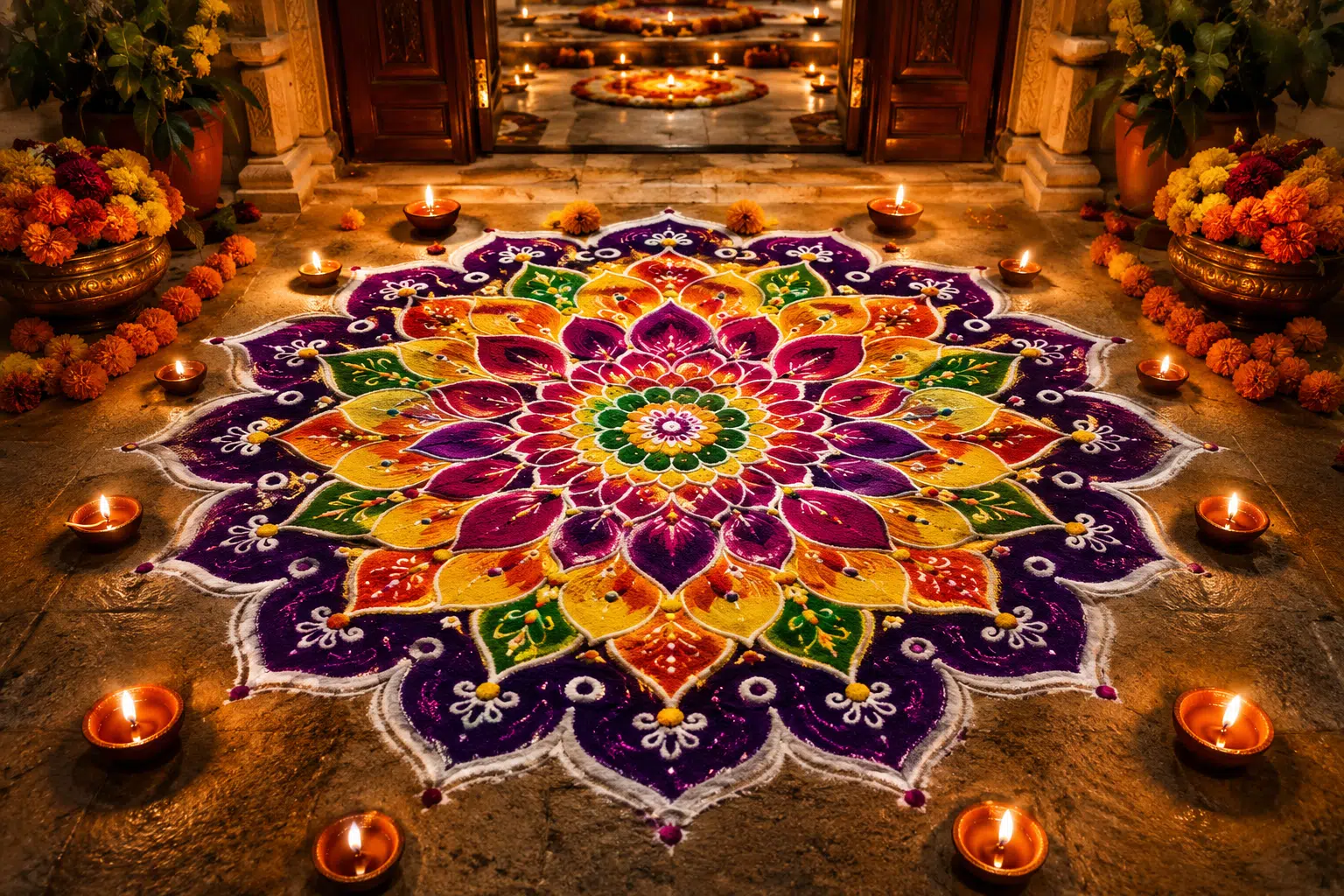
Diwali Rangoli Design Ideas: 8 Easy & Traditional Designs for 2026
Rangoli is one of the most loved parts of Diwali. Drawn at the entrance and in the courtyard, these colourful floor patterns welcome guests and, by tradition, Goddess Lakshmi on the night of Lakshmi Puja. Below are eight design ideas, from a 15-minute beginner circle to a full flower-petal centrepiece, with colour combinations and practical tips.
Diwali 2026 falls on Sunday, 8 November, with Dhanteras on 6 November. Many families draw their first rangoli on Dhanteras and refresh it each day until Bhai Dooj.
What is rangoli?
Rangoli is a decorative pattern made on the floor with coloured powder, rice flour, flower petals, sand or chalk. It goes by many regional names, including kolam in Tamil Nadu, muggu in Andhra Pradesh and Telangana, alpana in Bengal and mandana in Rajasthan. Some styles, such as kolam, are drawn daily at the doorstep, while Diwali rangolis are usually larger and more colourful.
Why rangoli is made during Diwali
- Welcoming Lakshmi: a clean, decorated entrance is believed to invite the goddess of prosperity on Diwali night.
- Hospitality: it greets guests and family visiting during the festival.
- Auspicious beginnings: rangoli is drawn for many celebrations as a sign of good fortune.
- Family tradition: making it together, often by women of the household, is part of the festival itself.
8 Diwali rangoli design ideas
1. Simple circular rangoli
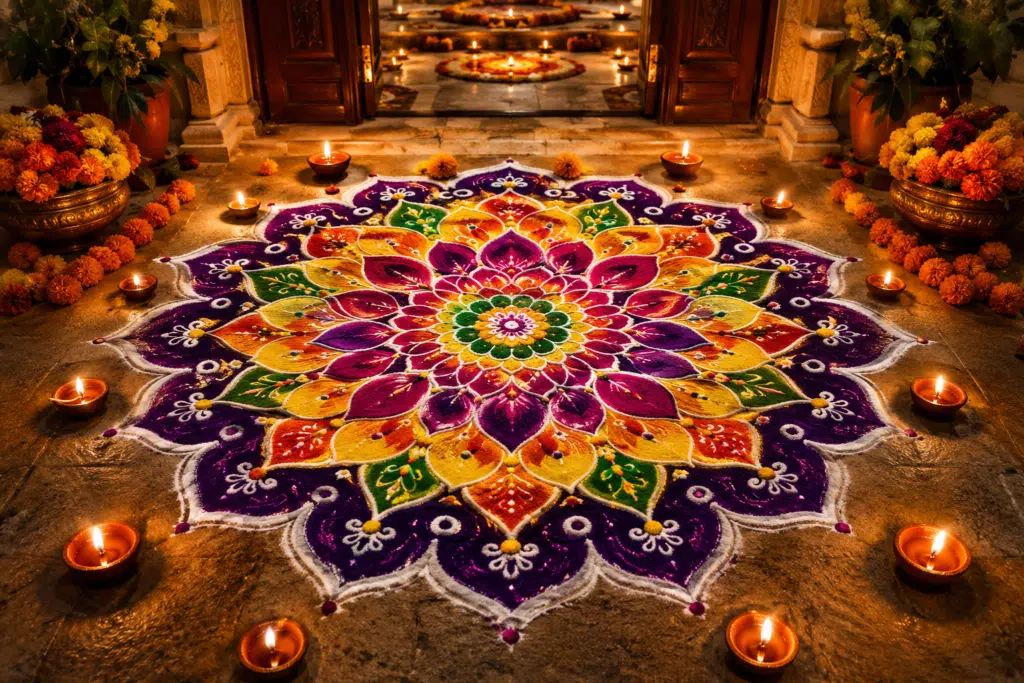
A circle divided into rings of petals is the easiest place to start. Draw a small central circle, then two or three rings outward, and fill each ring with a single colour. Best for beginners; uses 3–5 colours; about 15–30 minutes for a 2-foot design.
2. Lotus rangoli
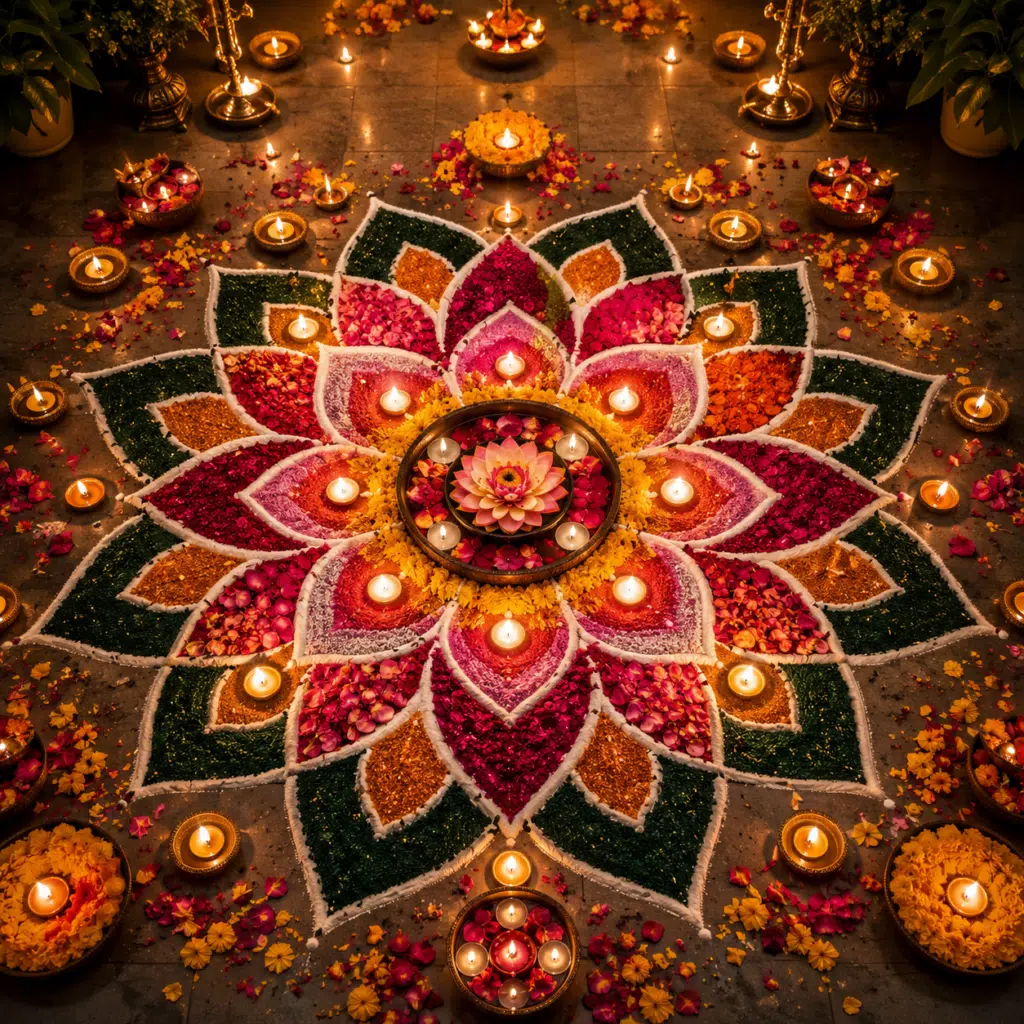
The lotus is associated with Goddess Lakshmi, who is often shown seated on one, which makes it a natural choice for Lakshmi Puja. Layer pointed petals in pink and red, outline them in white, and add green leaves at the edges. Medium difficulty.
3. Flower-petal rangoli
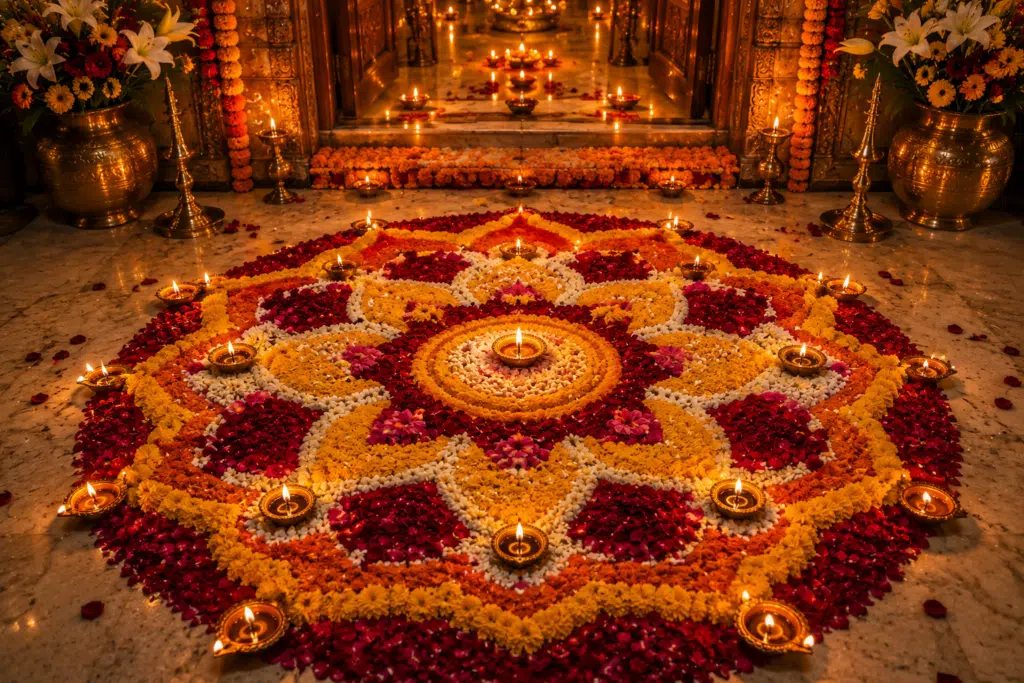
Made with marigold, rose and chrysanthemum petals instead of powder, this style is fragrant, eco-friendly and easy to clean up. Sketch the outline with chalk, then fill sections with petals of one colour at a time. Make it on the day, as petals wilt within a day or two.
4. Diya-centred rangoli
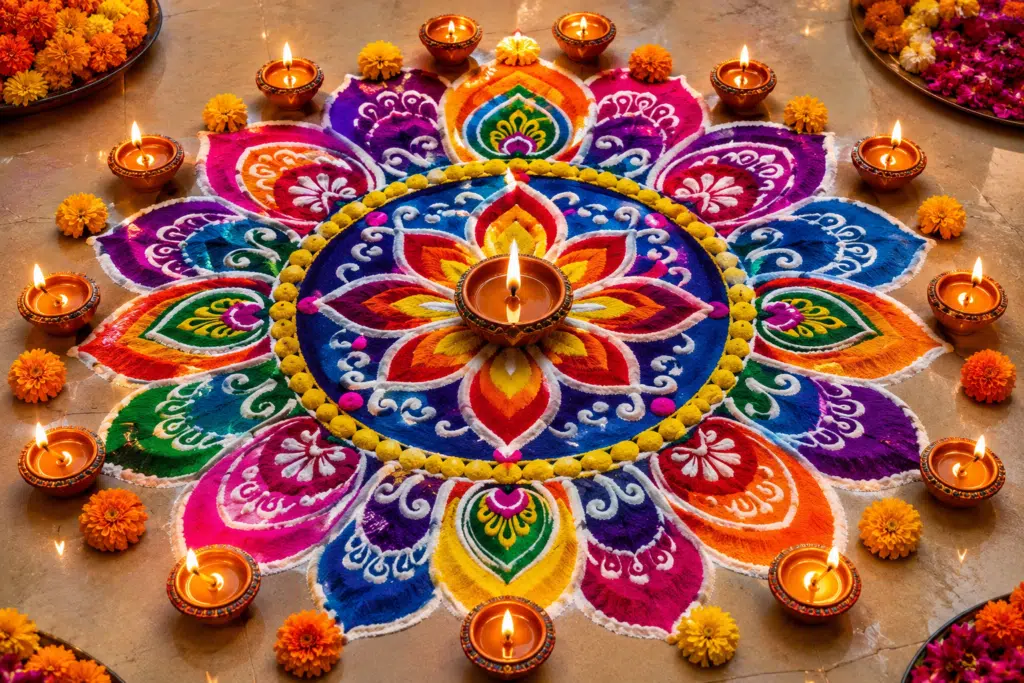
Place a real or drawn diya at the centre and radiate petals or paisley shapes outward in bright colours. Ring the design with small clay lamps for Diwali night. Keep a little distance between the flames and loose powder or petals.
5. Dot (kolam-style) rangoli
Lay a grid of dots with rice flour or chalk and join them with curves and loops. This South Indian style needs only one colour and looks striking at a doorstep. Graph-paper practice helps before drawing on the floor.
6. Peacock rangoli
A peacock with a fanned tail in blue, green and turquoise suits large entrances. Draw the body first, then the tail feathers as overlapping teardrops with “eye” spots. Advanced; allow an hour or more.
7. Swastika and Om rangoli
A small Hindu swastika or Om at the threshold, surrounded by a simple border, is a traditional auspicious design for Lakshmi Puja. It is quick to make and works in small spaces such as apartment doorways.
8. Footprints of Lakshmi
Small pairs of footprints drawn in rice paste or red powder leading from the entrance towards the puja room represent Lakshmi entering the home. Many families add them on Dhanteras or Diwali, alongside a main rangoli.
Best colour combinations for Diwali rangoli
- Yellow and orange: warm and festive; pairs well with diyas.
- Red and white: traditional and high-contrast for doorsteps.
- Pink, magenta and green: ideal for lotus and floral designs.
- Blue and turquoise with green: natural for peacock designs.
- Gold and maroon: elegant for indoor puja areas.
Use a white or light outline around each colour block to make the pattern stand out, especially on dark floors.
Tips for a neat rangoli
- Sweep and dry the surface first so powder does not clump.
- Sketch the outline in chalk before adding colour.
- Work from the centre outward so you do not smudge finished sections.
- Use a cone, a small sieve or a tea strainer for fine, even lines.
- Fill one colour at a time and keep each colour in its own bowl.
- Place diyas only after the rangoli is finished, and away from loose petals.
- For outdoor designs, choose a sheltered spot or sprinkle a little water on the edges to reduce wind damage.
Common mistakes to avoid
- Using too many colours, which makes a design look muddy.
- Choosing a pattern too large or complex for the time available.
- Skipping the outline, which leads to uneven symmetry.
- Making it where people walk through or where it gets no light at night.
Frequently asked questions
What is the easiest Diwali rangoli design?
A simple circular design, a dot (kolam) pattern or a small diya motif. Each uses few colours and can be finished in under half an hour.
Why is rangoli made on Diwali?
Rangoli decorates the entrance to welcome Goddess Lakshmi and guests during Diwali, and is considered a sign of good fortune.
What materials can be used for rangoli?
Coloured powder, rice flour, flower petals, coloured rice, sand and chalk. Rice flour and flower petals are the most eco-friendly choices.
When should I make rangoli for Diwali 2026?
Many families start on Dhanteras (6 November 2026) and make or refresh the main rangoli on Lakshmi Puja day, Sunday 8 November 2026.